

A shiatsu massager is not a massage chair, and a recliner is not a treatment table. That sounds obvious until you watch somebody drop one behind their back, lean the chair all the way out, and then wonder why they are sorer an hour later than they were before. I did nearly the same thing the first week I had mine. Lorraine gave me the Zyllion ZMA-13 for Christmas last year, and I had it out of the box and wedged behind my lower back before the wrapping paper made it to the trash can.
Two things were wrong with that. The chair was laid back too far, so the unit slid down toward my hip instead of staying where I wanted it. And I had only a thin shirt between me and those deep-kneading nodes, which felt less like relief and more like somebody's knuckles. It took about two weeks of fussing to land on a setup I still use, roughly two or three times a week once the yard work starts. None of it is complicated. But the difference between a massager that earns its spot on the floor and one that ends up in a closet is almost entirely in how you set it up.
The one that stayed out of the closet
The Zyllion ZMA-13 is the massager on the floor beside my recliner, eleven months in and still in the rotation. Corded, under four pounds, heat that runs while the massage runs, and it comes with both a wall adapter and a car adapter.
Amazon Check Today's Price on Amazon →Step 1: Set the chair before you plug anything in
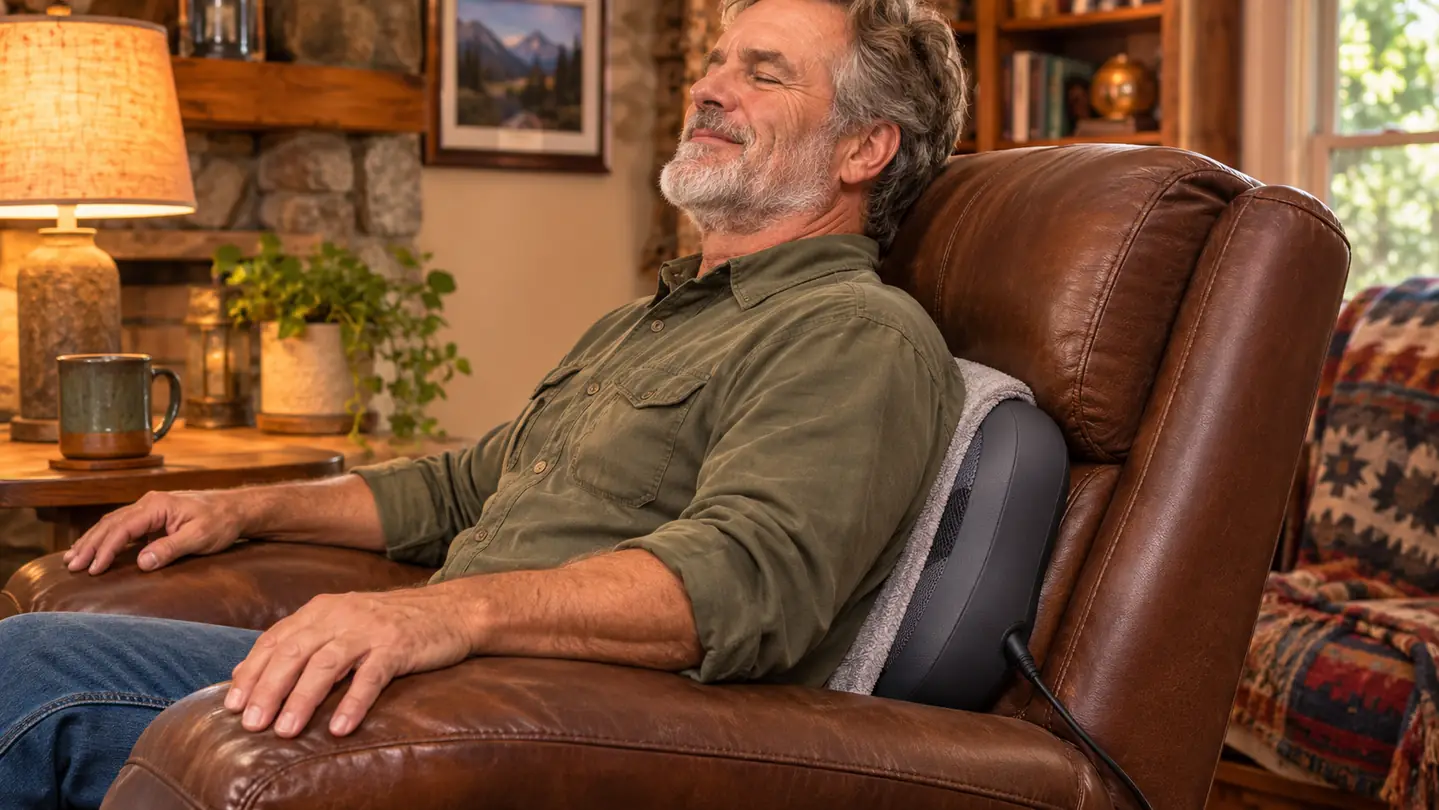
Start with the chair, not the massager. Bring the backrest up until it is close to upright, a couple of inches off vertical, and put the footrest down. I know that is not what a recliner is for. But a shiatsu unit does its work by pressing into you, and when the chair is laid back far, gravity drags the thing down your back while you fight to hold it in place. Fifteen minutes of that is not rest. It is a wrestling match with a pillow.
My first night with it, I had the chair three notches back from where it sits now, because that is how I watch television. Within four minutes the massager had worked its way down from my belt line to the top of my hip, and I spent the rest of the session hitching it back up with one hand. It took four evenings of trying different backrest positions to find the one that holds. Now the chair goes to the same spot every time, and I can find it without looking.
Next, sort out the power before you sit down. The Zyllion is corded electric rather than battery, so you want the cord run behind the chair and out of the walking path, and the adapter plugged into something you are not going to kick on the way to the kitchen. Mine shares a strip with the reading lamp. The unit itself lives on the floor at the side of the recliner, which is where it has sat since the week after Christmas.
Then clear the arms of the chair. Remote, phone, glasses, glass of tea, all of it within reach before you lean back. A session is fifteen minutes of not twisting. If you have to turn and reach for something on the far side table halfway through, you have just undone the part that was helping.
Step 2: Put it where your trouble actually is
Placement is the whole game. For lower back work, the massager sits behind you at your belt line, not up between the shoulder blades. Sit down first, slide it in behind you, then lean back and let your own weight hold it against the chair. The contoured shape is what keeps it against your back rather than sliding off to one side, but it needs a little help from you to get there.
It also wants to be centered, not off to one side. I had mine riding a little to the right for the first week, because I was setting it down from the right side of the chair and never checking. By the end of fifteen minutes my right side had been worked over and my left side had not been touched. Sit down, slide it in from behind, then reach back and check with your hand before you lean all the way back. Ten seconds of fussing saves the whole session.
At 13 by 9.5 by 3.5 inches and just under four pounds, it is easy to move from floor to chair and back again. Mine goes back on the floor when I am done, partly for tidiness and partly so nobody wanders into the den, sees it sitting in the chair, and assumes it is a cushion. It is not a cushion. Nobody who has leaned on one by accident has made that mistake twice.
The Zyllion will do neck and shoulders too, and the contoured shape is meant for that job as well. For that you want the chair more upright still, the massager up behind your neck, and your head resting back into it. I have done that maybe three times. It works fine. The lower back is what complains after I push a mower for an hour, so that is where mine earns its keep. Put yours where your own trouble is, not where mine is.
Step 3: Put a towel between you and the nodes
Here is the part that took me two weeks to accept: put a towel between you and the unit. A thin shirt is not enough of a barrier for those silicone nodes, at least not on my back. The first several sessions left me sore in a way that was not the useful kind, and I had just about decided the whole thing was overkill when Lorraine suggested a towel. A folded bath towel across the lower back changed it completely. Same unit, same fifteen minutes, different result.
Her suggestion came on a Sunday evening in January, after I had complained about the soreness twice in one week. She handed me a bath towel out of the linen closet, folded in half twice. My first thought was that I was wasting pressure I had already paid for. My second thought, fifteen minutes later, was that I had been doing it wrong for two weeks. I have used some version of that towel ever since. In summer I go to a thinner one, because I am warm already and the pressure feels different on a hot day. Come January I am back to the thick one.
Start with more towel than you think you need, then take it down a layer once you know how it feels. The heat is gentle and only runs while the massage is running, so the towel does not block much of the warmth. It just softens the pressure. If you have ever had a massage therapist tell you to speak up when something is too much, this is the same instruction. You are allowed to make it gentler. That is not cheating.
Step 4: Set your time and your posture before you start
Set your time before you start. Mine is fifteen minutes on the lower back, after yard work, and that is what my physical therapist Anita and I settled on. It is short enough that I actually do it. When I aim for thirty, I find reasons to skip it.
The unit has an auto shut-off, which is a decent backstop if you are the sort to drift off. I do not lean on it. I set a timer on my phone, put the phone face down on the arm of the chair, and get up when it goes off. Falling asleep in a recliner with a massager behind your back is easy to do at eight in the evening and a poor way to start the next morning.
Posture while you are in there matters more than people expect. Back resting into the unit rather than hunched forward over a phone. Feet flat if the footrest is down, or legs out but not locked. And pay attention to what you are pressing into. If it feels like it is grinding on bone rather than working on muscle, you are in the wrong spot. Move it an inch and lean back again.
Step 5: Tie it to something you already do
Tie it to something you already do or it will not survive week three. Mine is welded to the mower. The mower goes back in the garage, I wash up, and I sit down for fifteen minutes with the massager on and the heat going. Two or three times a week from spring through fall. Less in the winter, when the yard work stops and my back has less to complain about.
The mulch day is the clearest example of how this goes. Last April I spread eleven bags across the front beds on a Saturday morning, wore the brace, lifted with my legs, and finished up around noon. By one o'clock I was stiff the way I always am after that job. I did fifteen minutes in the recliner with the towel and the heat, and then I got up and made a sandwich instead of going to lie down for the afternoon. That is the only test I apply to any of this gear now. Did I get up afterward, or did I stay in the chair?
I also know when to leave it alone. If my back is angry in a sharp, hot way rather than a dull, tired way, I skip the massager and use the heating pad instead. This thing is for muscle soreness after effort. It is not what I reach for on a bad morning before I have even moved around the house. That is what the mat by the bed is for.
About the car adapter. It comes in the box, and I tried it twice, both times parked at the stop in Calhoun on the drive up to see my daughter in Chattanooga. It worked fine. I stopped bothering because getting it positioned in a truck seat is fiddly and I would rather just drive. Never while the truck is moving. That is not a massage, that is a distraction, and no gadget is worth that.
What Else Helps
The massager is one piece of a week, not the whole week. Mornings start with the back stretcher on the floor beside the bed, five minutes before my walk. That is what takes the edge off the first twenty minutes of stiffness. The recliner work comes later, after effort, not first thing. Doing it in the wrong order was something I got wrong for a while, and it took a couple of sore afternoons to notice.
Evenings, the heating pad over the arm of the recliner does the broad warmth job. Twenty minutes, around eight, with a shirt between me and the pad. Those two are not the same tool and I do not treat them as one. The pad is for warmth across a wide area. The massager is for pressure in one spot. Neither one cures anything, and I would be lying if I said otherwise.
For the rest of it: the lumbar pillow lives in the truck and handles the three hour drive to Chattanooga. The brace hangs on a hook in the workshop for mulch days. The walk happens most mornings, thirty minutes around the neighborhood, and I carry nothing on it. Anything sharp, new, or getting worse goes to Anita or the doctor. A gadget is a comfort, not a diagnosis.
Fifteen minutes, two or three times a week, tied to the mower going back in the garage. That is the entire routine, and it is the only version of it I have kept up for eleven months.
The setup that survived eleven months in my den
No app, no battery, nothing to learn. A corded massage pillow, a folded towel, a recliner brought up close to upright, and fifteen minutes after the yard work is done. Mine was a gift from Lorraine. I would buy it myself now.
Amazon Check Today's Price on Amazon →