

My lower back has been stiff every morning since about 2014. Not the kind of pain that puts you on the floor, just a long, slow ache that takes twenty minutes of moving around before it loosens up. I spent thirty-one years in a county bus garage in Macon, most of it bent over an engine bay or flat on my back under a chassis, and I retired in 2021 with a back that wakes up before the rest of me does. I have tried the cheap fixes. A rolled bath towel in the truck. A posture strap that spent two weeks on my shoulders and the next three years in a drawer. What I wanted from the ChiFit back stretcher was not a cure. I wanted five minutes in the morning that made the first half hour of the day less of a negotiation.
I bought the ChiFit Multi-Level Back Stretching Device in June of 2026, which makes this about five months of daily use. Before I ordered it I asked my physical therapist, Anita, whether it was a reasonable thing to have in the house. She said yes, with one condition: start on the lowest level and stay there a while. I stayed on level 1 for three weeks. I have been on level 2 since. I tried level 3 exactly once and went back down the next morning. That is the shape of the whole review, and if you take nothing else from it, take the part about level 1.
The Quick Verdict
Cheap, small, and easy to use before your feet are properly awake. It made my morning stiffness let go sooner, but it is a five minute habit and not a fix, and the first two weeks felt worse before they felt better.
Amazon Check Today's Price →The five minute habit I actually kept
Five months in, this is still on the mat beside my bed. Three levels, about a pound, nothing to charge and nothing to plug in. Start on level 1 and stay there three weeks.
Amazon Check today's price on Amazon →How I've Used It
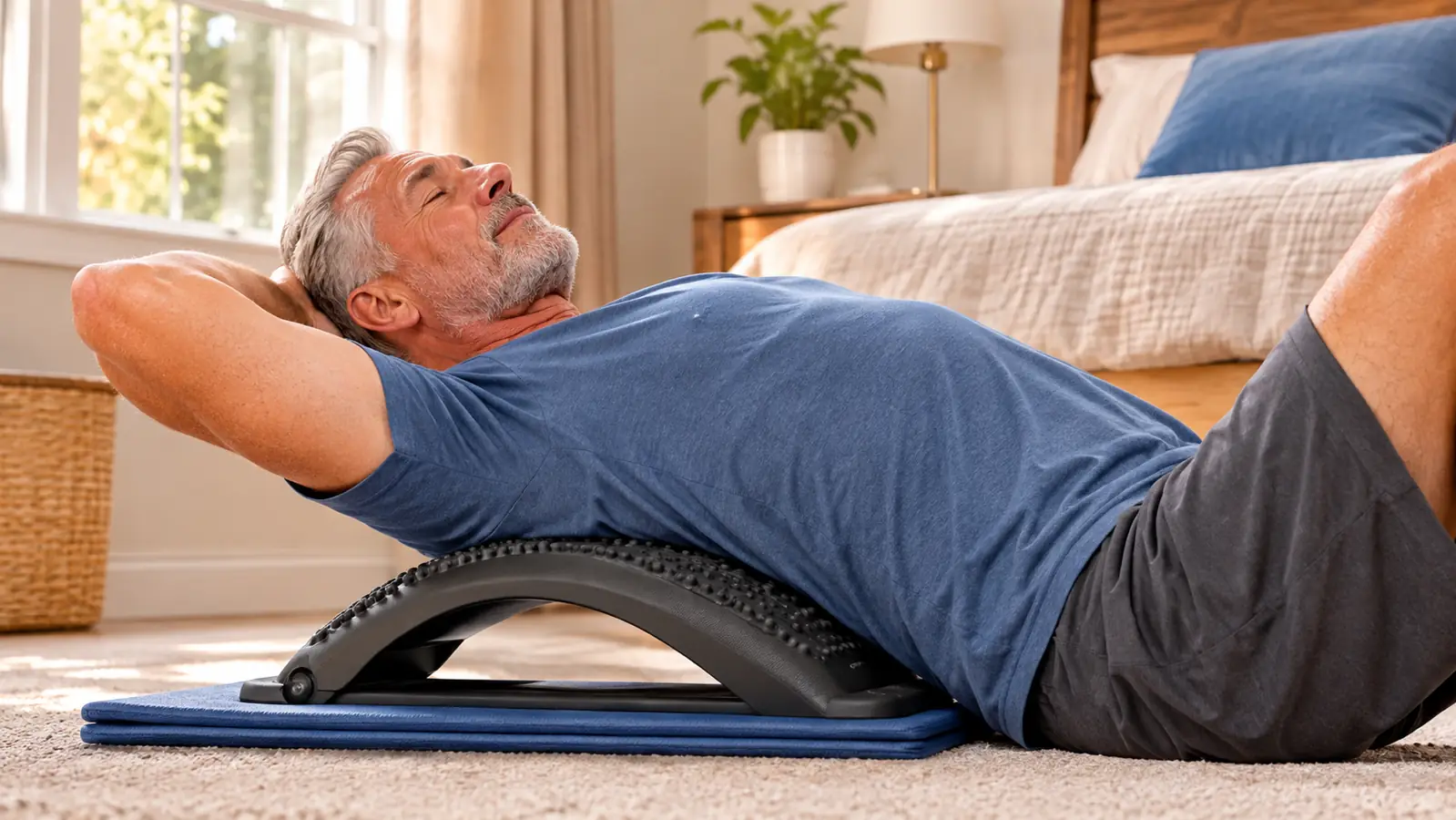
The device lives on a folded exercise mat on my side of the bedroom floor, next to the bed. That location matters more than it sounds. When I had the foam roller out in the garage I used it maybe twice a month, because walking out to a cold concrete slab at 6:30 in the morning is a decision, and decisions are what kill a routine. On the bedroom floor it is not a decision. I get up, I use the bathroom, I lie down on the mat, and I am finished before my wife Lorraine is out of bed.
My routine is about as plain as it gets. I lie back over it with the curve under my lower back, roughly at my belt line, knees bent the first week while I got used to the position, then legs out flat once that felt fine. Arms out to the sides, or hands behind my head if my shoulders are behaving. Five minutes, timed on the phone I set face down on the mat so I am not tempted to pick it up and start reading something. Then I get up, put on my shoes, and do my thirty minute walk around the neighborhood. Anita's home program has four other things in it and I do those on the days I do them, but the stretcher and the walk are the two that happen every single morning.
It has not made the ache go away. I want to be clear about that, because some of the reviews I read before I bought it had me half expecting something dramatic in the first week. Five months in, my back is better managed than it was. It is not fixed. Mornings are still the stiffest part of my day. The difference is how long the stiffness lasts and how much of a fight it puts up about it.
What the Three Levels Actually Feel Like
There are three settings, and they change how much the curve pushes into your back. Level 1 is a mild bend. Level 2 is noticeably more. Level 3, for me, was a hard arch that my lower back did not want to argue with. Anita's advice to start low was correct for a reason I only understood later, which is that your back is not a hinge you can just crank open. The first time I lay back on level 1 I felt the stretch in roughly the right place, and that surprised me, because I expected to spend a week fighting the thing to get comfortable.
I stayed on level 1 for three weeks, and it felt like a long three weeks at the time. Around week three it started to feel like nothing much, so I moved up to level 2. Level 2 has been the setting ever since. I tried level 3 on a Saturday morning in August when my back was feeling good, which is exactly the kind of thinking that gets a sixty-three year old man into trouble. I lasted about ninety seconds, got up, and felt it in a bad way for the rest of the day. Back to level 2 the next morning, and I have not been tempted since.
The part your back rests on is firm foam padding over a stiff plastic body. It is not soft. If you are picturing a cushioned mat, that is not this. The padding is enough that it does not dig in, and not enough that you forget what you are lying on. The whole thing weighs a little over a pound. Fifteen inches long, a few inches tall, so it slides under the bed or stands on its side against the nightstand without any fuss. It takes up less floor than a pair of work boots.
What Changed After Five Months, and What Didn't
The first two weeks were not good. I want that in writing because nobody told me, and I spent a while wondering whether I had wasted the money. It was not sharp pain. It was a soreness low in my back, the kind you get the day after doing something you are not used to. It showed up in the morning and faded by mid-morning. Around week three it stopped. I do not know whether that was my back adjusting or the habit settling in, and I am not going to pretend I do.
Around week four, something small shifted. The morning stiffness did not go away, but it started letting go sooner. Before, I would get up and move carefully for a good twenty minutes, hunched over the coffee maker, easing into the day one step at a time. Now it is more like ten, sometimes a little less. That is not dramatic and it will not sell anybody anything, but it is the honest measurement I have. It is the difference between a morning that starts with a fight and a morning that starts with a grumble.
It also stacks well with everything else I do. The stretcher is the first thing. The walk is the second. The lumbar pillow in the truck handles the drive up to Chattanooga. The brace handles the days I am spreading mulch. The heating pad handles the evening in the recliner. None of them overlap much and none of them made the others pointless. What has not changed: long sitting still gets me, yard work still gets me, and if I skip three mornings in a row I can feel the difference by the fourth. That last part is the real test of whether a piece of gear is doing anything at all.
The morning stiffness did not go away. It just started letting go sooner, and that is the whole claim I am willing to make.
Fit, Height, and the Part Nobody Mentions
How a stretcher like this fits depends almost entirely on where you put it and how long your torso is. I am five foot ten and about two hundred pounds, and with the curve at my belt line it lands right where the stiffness lives. If I slide it up two inches it turns into a poke in the middle of my back and we do not get along. It took me the better part of a week to find that spot, which sounds ridiculous for something you just lie down on, but it is true. The first three mornings I had it too high.
Two practical notes. First, put something under it. Mine sits on a folded exercise mat on a carpeted floor, and that is enough. Bare hardwood with this under your back is a cold, hard five minutes and you will not keep the habit. Second, the position takes some getting used to. The first few times, your back will tell you it does not trust you. That is not a reason to push harder. That is a reason to go back to level 1 and stay there another week.
Getting up off the floor at sixty-three is its own project, and I mention it because nobody else does. I roll to one side, push up with an arm, and come up to a kneel. Nothing about the device makes that easier or harder. It is just the cost of doing business on the floor at my age, and if that is a real problem for you, a stretch you can do from a chair will suit you better than this will.

What I Don't Care For
The padding is thin and it does not stay cool. Five minutes in the summer and the foam under my back is warm and slightly damp, and I have taken to wiping it down with a dry cloth every few days. The care instructions say dry clean only, which for a piece of home exercise gear is a strange thing to read and a stranger thing to follow. I wipe it. That is as far as I go.
The bigger complaint is the first two weeks, and I have already made it. A line on the box or in the listing saying the first fortnight might feel worse would have saved me some doubt. I will also say plainly that I do not put much stock in the listing's language about pain conditions. I am not qualified to judge any of that and neither is a plastic arch. What I can tell you is what five minutes a morning did for one retired mechanic in Macon, Georgia, and that is a smaller and more useful claim than the packaging makes.
It also only does one thing. The ChiFit stretcher does not heat, does not vibrate, does not massage and does not tell you anything. You lie on it, you get up, you go for your walk. If you want a device that does more, this is not that device, and I would rather have one trick done well than four done badly. That is the whole reason it survived month two when most of the gear in my garage did not.
Where It Sits Next to the Rest of My Gear
I have a thirty-six inch foam roller in the garage that Anita suggested back in 2024. I still use it now and then, mostly on my thighs after a long drive, and it does a job the stretcher does not. The difference is that the stretcher is passive. You lie there and it holds a curve in your back. The roller is work, and after a session on it I am tired in a way that is not always what I want at 6:30 in the morning. If I had to keep one, I would keep the stretcher, because it is the one I actually use.
The posture strap I bought in 2023 lasted two weeks and is in a drawer. The ChiFit stretcher has already outlasted it by a wide margin, which is the only comparison that matters to me. I borrowed my son-in-law's massage gun for a week in February and gave it back. It was fine. It was also another thing to charge, another thing to hold, another thing to think about. Five minutes lying on the floor requires no charging and no thinking, and at my age that counts for something.
None of this replaces the heating pad in the evening or the brace on mulch days. Those are different jobs at different hours. The stretcher owns the morning and nothing else, and it has not tried to claim more than that.
What I Liked
- Five minutes first thing, no setup and nothing to plug in or charge
- Three levels, and level 1 is genuinely mild enough to start on
- A little over a pound and fifteen inches long, so it stores against the nightstand
- Still part of my morning five months in, which is more than most of the gear I have bought
- The morning stiffness started letting go sooner around week four
Where It Falls Short
- The first two weeks felt sore, not good, and nothing warned me
- The padding is thin and gets warm and damp during a session
- Level 3 was too much for my back and I went back to level 2 the next day
- Care instructions say dry clean only, which is not going to happen in this house
Who This Is For
For a man or woman in their fifties or sixties with a stiff lower back that is worst in the morning, who has already been told by a physical therapist that stretching is part of the program, and who will actually lie on the floor for five minutes before the day starts, this is a sensible thing to own. It suits people who want a small habit and not a treatment. It suits people who have a spot on the bedroom floor and a walk afterward. And it suits anybody who has bought three gadgets and used each of them twice, because this one is simple enough to survive that pattern.
Who Should Skip It
Skip it if you have not asked a doctor or a physical therapist about your back first. I am not qualified to tell you whether lying back over a curve is a good idea for your particular spine, and neither is a product listing. Skip it if you want something that works while you sit in a chair, because this requires the floor and there is no way around that. Skip it if you will not do it daily, because five minutes twice a week did nothing for me and I tried it that way for a stretch. And skip it if you are looking for a device that makes pain go away. Nothing I own does that, including this.
Five months in, the ChiFit back stretcher is still on the mat beside my bed, and that is the highest compliment I can pay any piece of gear I have bought since I retired. It did not fix my back. It made the first ten minutes of the morning cheaper to get through, and it cost me five minutes a day to find that out.
If your mornings start with twenty minutes of walking it off, start on level 1
Ask your physical therapist first, then give it three weeks on the lowest setting before you decide anything. That is the order I did it in, and I would do it the same way again.
Amazon See the current price on Amazon →