
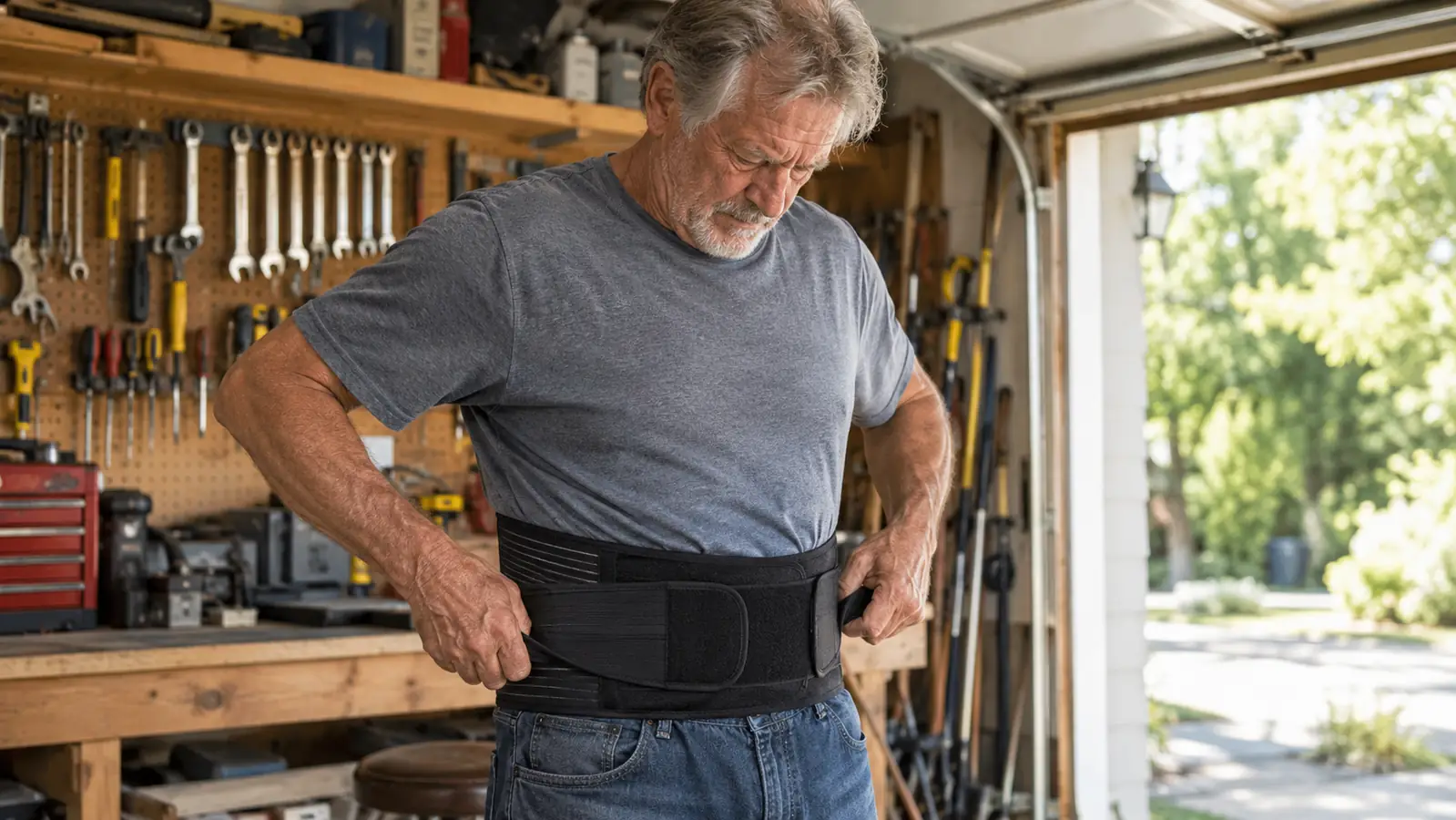
I spent 31 years bent over engines and under chassis in a county bus garage. My lower back has been stiff and sore since about 2014, worst in the morning and after a long sit. My physical therapist, Anita, gave me a home stretching program in 2022, and I check in with her about twice a year. Nothing I own has made the pain go away. What I have figured out is which gear earns its hook on the garage wall and which gear ends up in a drawer next to a posture corrector I bought in 2023 and wore for two weeks.
The MUELLER lumbar back brace is one that earns its hook. I bought the Regular size in April 2026, the week before I spread mulch, after asking Anita whether it was fine to wear one. She said fine for heavy days, not for all day. That distinction is the whole ballgame, and it is also where most people get the fit wrong. A brace that sits too low does nothing but rub your hips. A brace cranked down tight enough to feel like it is working will have you taking it off in twenty minutes.
The Regular size fits waists 28 to 50 inches, so measure before you order
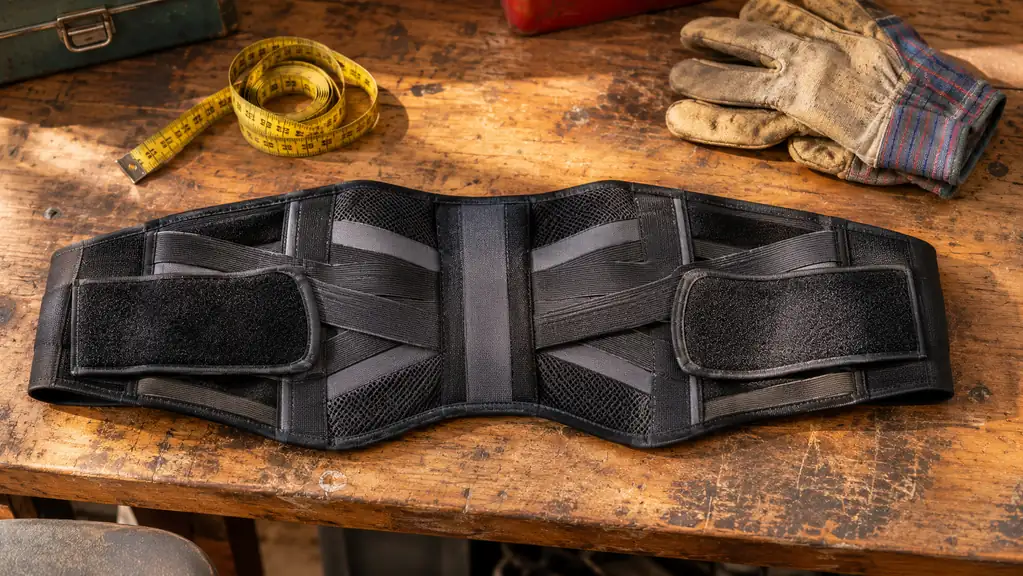
I measured around the widest part of my waist, not my hips and not my pant size, and the Regular landed where it should. It has four steel springs in the back and a removable pad, and it hangs on a hook in my workshop between uses.
Amazon Check Today's Price on Amazon →Start With a Measurement, Not a Guess
Before any of the fitting steps matter, you need the right size on your body. MUELLER publishes three ranges: Small fits 22 to 30 inches, Regular fits 28 to 50 inches, and Plus goes up from there. Run a cloth tape around the widest part of your waist, which for most of us is at or just above the navel, and keep the tape level all the way around. Do not measure over a thick sweatshirt. Do not go by the size pants you bought last spring, because waistbands lie.
I landed in the Regular and I have room to spare on both ends of that range, which is the point of a range that wide. The overlaps between sizes are real, so if you measure 29 inches you could plausibly wear either the Small or the Regular. I would take the larger of the two. You want the two ends to overlap enough to fasten comfortably, not to meet exactly at the edge with nothing to spare.
One more thing before you start. The brace is 16 ounces. That sounds light, and it is light, but you will know it is on. If you are expecting to forget you are wearing it, you will be disappointed, and that is true of every brace I have handled. Lightweight is not the same as invisible.
Step 1: Put It On Over a Shirt, Standing Up
Put the brace on over a t-shirt, not against bare skin. The material is neoprene and polyester, and against skin it gets clammy fast. Anita told me the same thing: a barrier layer keeps the brace from digging in and keeps you from needing to wash it every other day. A plain cotton t-shirt is enough. Tuck it in if you are going to be bending, so the shirt does not ride up underneath and bunch into a rope.
Stand up to put it on. Sitting down compresses everything, and you will fasten it tighter than you can tolerate standing, then spend the next hour trying to discreetly loosen it in front of people. Stand with your feet about shoulder width and flat on the floor, and hold the brace with the pad centered on your spine.
The brace is adjustable and the two ends meet at the front. Bring them together and close them lightly. Do not bear down on it yet. You are only getting it to stay on your body while you position it, and you will adjust it twice more before you are done.
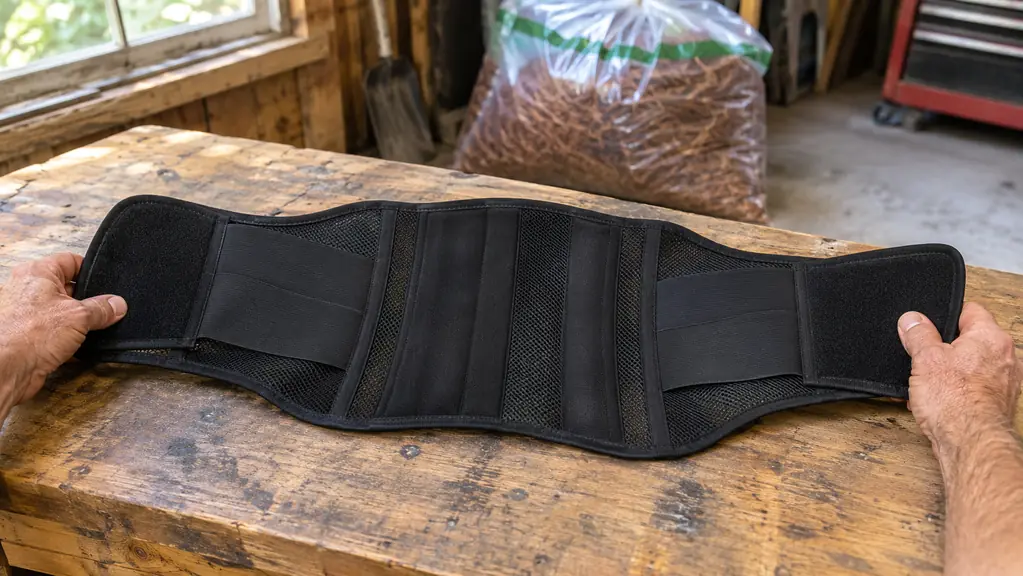
Step 2: Set the Height at Your Belt Line
This is the step people skip, and it is the one that decides whether the brace helps at all. The pad and the four steel springs need to sit across your lower back, roughly at the height of your belt line, centered on the spine. Not down over your tailbone. Not up between your shoulder blades. I see folks wearing these low, riding on the hips like a weight belt, and then telling me it does not do anything.
It took me about a week of fiddling to find my height, and I found it by paying attention to where the springs landed rather than to how the front looked. Slide the brace up and down with the closure barely fastened until the firm part sits right across the sore spot, level with the ground all the way around. If it is tilted, one side digs in and the other floats, and you will feel the dig within ten minutes of real work.
The MUELLER pad is removable, and mine is in. If the pressure feels too sharp in one spot, take the pad out and try it without, or shift the whole brace a half inch and see if that settles it. Small moves, not big ones. Give each change ten minutes of moving around before you decide.
Step 3: Tighten Until Firm, Then Back Off One Notch
Here is where I would push back on most of what you read about these. People equate tight with supportive, and they crank the thing down until they can feel their pulse in their ears. That is not support, that is a tourniquet with extra steps. The brace should feel firm and even across your whole lower back, like a flat hand pressing, not like a band biting in at two points.
My rule: fasten it until it is snug, then take it back one notch. You should be able to slide a flat hand under the front edge with a little effort. You should be able to take a full breath without the brace fighting you. You should be able to sit down without it jamming up into your ribs.
Test it before you commit to a chore. Bend forward like you are picking something up. Twist a little. Reach overhead. If the brace rides up your back, it is too loose. If it pinches at the hip bones, it is too tight or sitting too low, and go back to Step 2 before you touch the tension again.
Step 4: Do a Trial Chore, Not a Trial Day
Do not put the brace on for the first time and go spread nine bags of mulch. Give it twenty minutes of real but modest work in the yard or the shop and pay attention. Anita's rule for me was heavy days only, never more than two or three hours, and I have stuck to it. My first day in it was a mulch day in April 2026, and I felt it help because it kept reminding me to lift with my legs instead of folding at the waist.
That reminder is the actual mechanism, as far as I can tell from my own body. The brace does not make your back stronger. It gives you a physical cue every time you start to bend badly, and it holds things steady while you lift. It does not replace strength and it does not replace the stretching Anita gave me. If you wear it and keep lifting like a fool, you have bought yourself a belt.
Watch for the two signals that mean stop. Numbness or tingling anywhere in the legs, or marks left on your skin that are still there an hour after you take the brace off. Either one means it is too tight or the fit is wrong. Take it off and start over at Step 2. And if numbness shows up and stays after the brace is off, that is a call to your doctor, not a fitting problem.
Step 5: Take It Off, and Take It Off on Time
This is the last step and the one I would underline twice. The brace comes off when the chore is done. Mine hangs on a hook in the garage workshop and it stays there. I do not wear it on my 30 minute morning walk. I do not wear it in the truck on the drive up to Chattanooga. I do not wear it to the recliner in the den.
The reason is simple. If you wear a brace all day, your own muscles start letting it do the work, and that is the opposite of what you want at my age or at any age. Heavy chore days, a couple of hours, then off. When I asked Anita about it, that was essentially her answer, and she has been right about enough things that I did not argue with her.
Take it off before you sit down for the evening. Open the closure slowly instead of ripping it, and let your back settle for a minute before you stand up again. Fold the brace with the closure stuck to itself so the back side does not grab everything else on the hook, and wipe the inside down with a damp cloth now and then. The material is odor resistant, but odor resistant is not self-cleaning, and you are wearing it over a shirt that is getting sweaty.
The brace does not make your back stronger. It reminds you, every time you start to bend badly, that you have a back.
What Else Helps
A brace is one tool among several in my house, and none of them is the star. Five minutes on the ChiFit stretcher every morning about 6:30, then the walk. That order matters more to my mornings than anything else I do. Anita set me on the lowest level and I stayed there three weeks. The first two weeks felt sore, not good, and around week four the morning stiffness started easing sooner. Still there, just not as long.
The Everlasting Comfort lumbar pillow lives strapped to the driver's seat of the 2016 F-150. That started after a drive to see my grandkids in Chattanooga that left me stiff at the Calhoun stop, about two hours in. It took me a week of moving the straps to get it to my belt line, and I noticed the difference on the next trip up I-75.
The Pure Enrichment heating pad is an evening thing, draped over the arm of the recliner, about 20 minutes around 8 p.m. on setting 3 of the 6, with a shirt between me and it. The Zyllion massager sits on the floor next to the recliner and comes out after yard work, 15 minutes, heat on, a towel over it because the nodes are too much on bare skin through a thin shirt. Both of those ease an evening. Neither one is doing anything for the next morning.
If you only buy one thing, I would not tell you it is the MUELLER brace. I would tell you to start with the stretching program, because it costs nothing and it is the piece I would not give up. The brace is what I reach for on the days that ask more of my back than my back wants to give, and those days are mulch days and mower days, not Tuesday.
There is also a drawer in the bedroom with a cheap posture corrector in it. I wore it two weeks in 2023 and gave up, because it pulled my shoulders back without teaching me anything. A 36 inch foam roller lives in the garage at Anita's suggestion and gets used now and then. Both of those were cheaper than the brace and neither one earned its hook.
And if your back is genuinely getting worse, or you have numbness, or it is waking you up at night, none of this is the answer. Go see somebody. I put it off too long myself, and eight weeks of physical therapy in 2022 did more for me than five years of guessing.
Measure your waist, pick the Regular if you land anywhere from 28 to 50 inches
Four steel springs, a removable pad, and a closure you can adjust with one hand. Mine has been on a hook in the workshop since April and it will be there for the next mulch season.
Amazon Check Today's Price on Amazon →