

If you have looked at the ChiFit back stretcher online, you probably had the same first thought I did. That is a curved piece of plastic. It is. A curved piece of plastic with a foam pad along the top of the arch, roughly the length of your forearm and about as heavy as a full coffee mug. I have used one every morning for five months now, and I want to tell you plainly what it does and what it does not do, because the box and the product page both oversell it.
I am 63. I spent 31 years in the county bus garage here in Macon, most of it bent over an engine or lying on a creeper under a chassis, and my lower back has been stiff and sore since about 2014. Mornings are the worst of it and always have been. When I asked my physical therapist Anita about a back stretcher last spring, she said it was fine to try, and to start on the lowest level and stay there a few weeks. That is the short version of this review. The rest of it is the detail, including the parts the listing leaves out.
The Quick Verdict
Five months in, it earns its square foot of bedroom floor. Start on level one and stay three weeks even if you feel ready for more. Expect a sore first fortnight and nothing dramatic at the end of it.
Amazon Check Today's Price →The lowest setting is the one that does the work
Three levels, and I have used two of them. If you are new to this, level one for three weeks is the whole job. The level details and today's price are on the listing.
Amazon Check Today's Price on Amazon →What the ChiFit Back Stretcher Actually Is
Stripped down, it is an arch. The frame is a hard plastic, ABS and PP according to the listing, with a foam pad fixed along the top curve where your back rests. The listing gives the size as 15 by 4 by 2.8 inches and a little over a pound, which matches my hand and my bathroom scale well enough. Three levels of curve are built into it, changed by a piece that clicks into a groove, and that is the entire feature list. No moving parts. Nothing to plug in. Nothing to charge. Nothing to replace.
The pad has a raised pattern across it, and that pattern is the part people either get along with or do not. I did not, at first. The first week it felt like lying back on a row of knuckles through a T-shirt, and I spent more of the five minutes thinking about my shoulder blades than about my back. Whether it softened or I did, somewhere in the second week it stopped bothering me. That is worth knowing before you buy, because if you quit on day four you will quit at the worst possible point.
How I've Used It, Morning by Morning
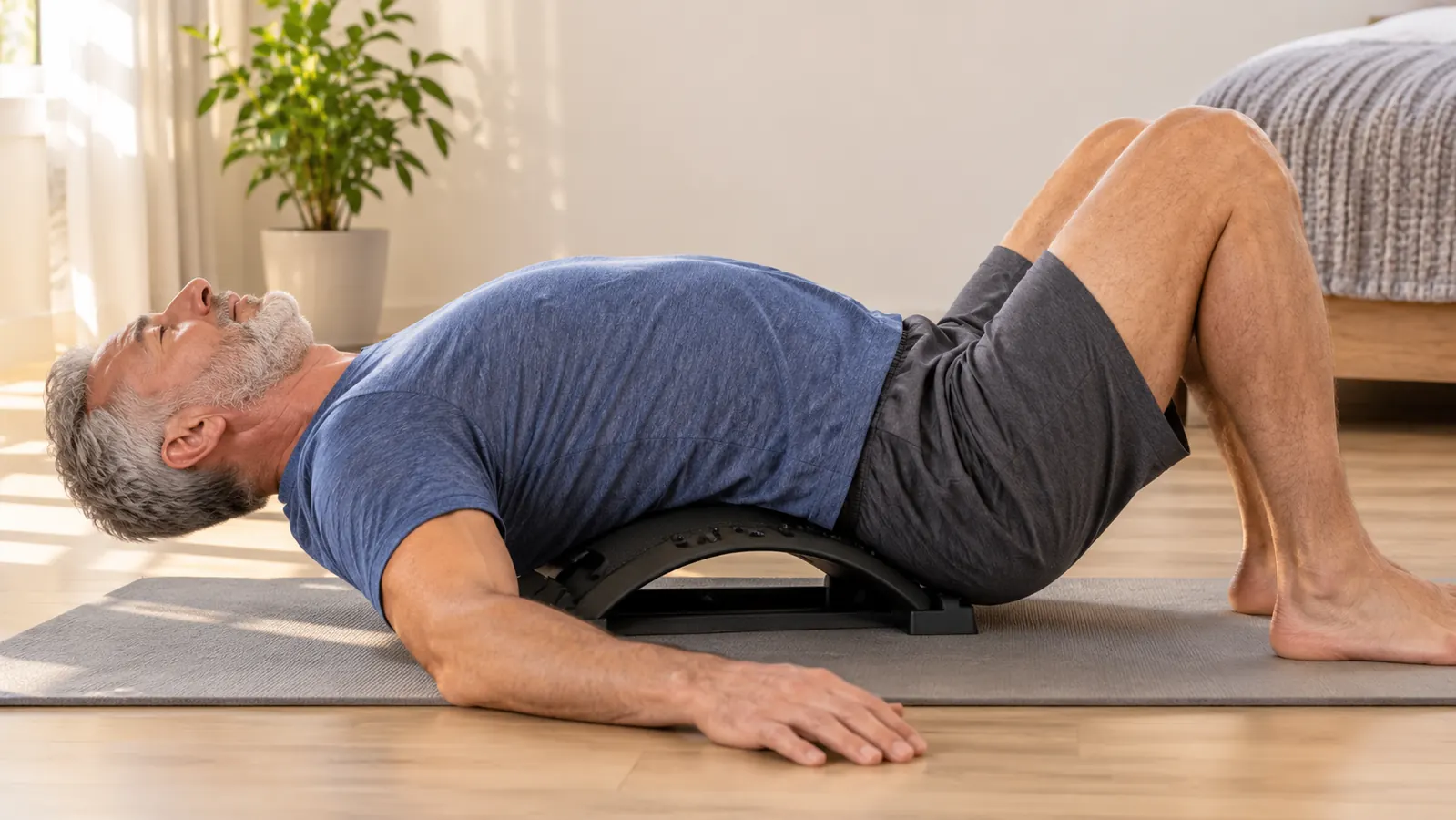
The ChiFit sits on a folded exercise mat on my side of the bedroom floor, next to the bed, and that is where it stays. About 6:30, before my walk, I lie back over it with the arch under my lower back and my knees bent, and I stay there five minutes. Then I get up, put my shoes on, and do the 30 minute loop around the neighborhood. Five months in, the only thing that has changed about that routine is which level I am on.
For the first three weeks I stayed on level one, because Anita told me to, and because level two felt like too much the one time I tried it early. Around week four I moved up. I have been on level two since June. I tried level three once, in August, and got about ninety seconds in before I decided I had nothing to prove to anybody. Level two is where I will stay.
Getting positioned took some fiddling. The first week I had it too low and it felt like it was pushing on my tailbone, then too high, where it did nothing at all. What worked was sliding it down until the top of the arch sat about a hand's width above my belt line, and letting my knees stay bent so my lower back settled onto the curve instead of bracing against it. Ten minutes would be too long for me. Five is the number where I stand up feeling looser instead of feeling folded the wrong way. That is my back and not a rule for yours, but if you try ten right out of the gate and it feels awful, that is likely why.
Around week four the stiffness started letting go sooner in the morning. It is still there. It just does not run my whole first hour anymore.
What Five Months Changed, and What It Didn't
Here is the part I want to be careful about. My back is better managed than it was a year ago, and I credit the whole routine rather than any single piece of it: five minutes on the floor, the 30 minute walk, the stretching program Anita set up for me back in 2022, and the fact that I have stopped hauling mulch bags around like a man in a hurry. If I skipped the arch for a week I could not honestly tell you how much worse I would feel, because I have not skipped it.
What I can tell you is that the first two weeks felt sore, not good. Not sharp and not injured, just a dull grumpy soreness across the lower back for an hour afterward. Anita had told me that was likely and to stop if it ever turned sharp or ran down a leg. It never did. If yours does, that is a call to your own physical therapist and not a note in a review column.
Somewhere in week four the morning stiffness started easing off sooner. It is still there when I swing my legs out of bed. It just does not run the first hour of my day anymore. That is a small, unglamorous result and it is the whole of what I got after five months. I would probably not have noticed it if I had not been doing the same five minutes at the same time every morning with something to compare it to.
The Honest Part: What Nobody Tells You
It is not comfortable. Some descriptions of this kind of item make it sound like a spa. It is a hard arch pressing into the muscles of your lower back for five minutes and you will be aware of it the whole time. The pad helps, and the raised pattern helps some people more than others. If what you want is something soft to lie on, this is the wrong purchase and you will know it inside a day.
The first fortnight is the worst of it, and that is where most people quit. I nearly did. There is the soreness afterward, the fiddling around to get positioned right, and the plain fact that five minutes on a bedroom floor at 6:30 in the morning is not how anyone wants to start a day. I kept at it because Anita had said to give it a month, and because five minutes is short enough that I could not argue my way out of it.
One more thing nobody mentions: on a hard floor it thumps and slides when you shift your weight. Mine lives on a folded exercise mat and that solved it. So budget for a mat if you do not already have one, because the mat is doing half the work of keeping the thing where you put it.
It does nothing for you while you are not on it. The ChiFit is not a brace and it is not a pillow. It does not support your back at the grocery store, in the truck, or in the recliner. I have other gear for those jobs and I still use all of it, every week. This one is five minutes of my morning and nothing else.
And the listing is louder than the product. The packaging names conditions I am not qualified to say one word about, and neither is a product page. It sits at about four stars across more than six thousand ratings, which is roughly what a thing like this should be: plenty of people it helped a little, and a real share it did not help at all. What I can tell you is what happened on my bedroom floor. Anything past that, ask somebody who has actually looked at your back.
What I Liked
- Takes up about a square foot of floor and weighs a little over a pound
- Three levels, so there is a starting point and somewhere to go later
- Five minutes is short enough that I have not quit it in five months
- Nothing to charge, plug in, or replace
- Wipes clean with a damp cloth in about ten seconds
Where It Falls Short
- The first two weeks feel sore, and that is where most people stop
- Not comfortable at any point, only tolerable
- The raised pattern on the pad is not for everyone
- Does nothing for you outside the five minutes you are on it
- The listing makes claims well beyond what a plastic arch can do
Where It Fits Against the Other Gear I Own
I own a 36 inch foam roller I bought in 2024 at Anita's suggestion. It lives in the garage and I use it now and then. The roller and the arch are different jobs and I would not swap one for the other. The roller is for working along the length of a muscle and it takes some balance and effort to use. The arch is for lying still while your own weight does the work. On a morning when my back is grumpy, the arch is the easier of the two, because all I have to do is lie there and breathe.
I also have a posture strap from 2023 that I wore for two weeks and put in a drawer. I would not recommend that purchase to anybody, and it is a different kind of item with a different kind of failure. Worth saying out loud, though: a flat plastic arch has outlasted it by years in this house, and the arch asks less of my morning.
I thought about taking it to Chattanooga in July and decided against it. Three hours up I-75 with one stop at Calhoun is not the problem. The problem is that I would be lying on my daughter's floor at 6:30 in the morning with two grandkids running through the room. It stays home. If you travel a lot and want one in a suitcase, it packs about as well as a pair of boots, so it can be done.
Fit, Size, and the Small Stuff
The arch is 15 inches long and 4 inches across per the listing, so it sits under your lower back and not much else. If you are broad through the shoulders, or you want something that spans your whole back, this is not that item. It is a small, targeted thing. I am 5 foot 10 and about 195 pounds and it sits under me fine, though it took me a week to find the spot that felt right, which for me is about a hand's width above my belt line.
Two small notes. The listing says dry clean only, which I found funny for a plastic arch, so I have wiped mine with a damp cloth and let it air dry since the first week with no harm done. And the level piece clicks into a groove, so if you carry it around or toss it in the back of the truck, check that it is seated before you lie back on it. Mine has come loose once.
Who This Is For
If you are like me, stiff and sore in the mornings, already working a stretching program a professional set up for you, and willing to spend five boring minutes on the floor every day for a month before you judge the thing, this is a reasonable item to own. It also suits anybody in a small place, since it weighs about a pound and takes up less floor than a pair of boots by the door.
It suits people who like a starting point. Three levels mean you are not guessing on day one. You begin at the bottom, you stay there longer than you want to, and you move up when your back says so and not before.
Who Should Skip It
Skip it if what you want is comfort. Skip it if you want something that works while you sit at a desk or drive to see your grandkids, because it does neither of those. Skip it if you have sharp pain, pain running down a leg, numbness, or anything that has been getting worse rather than better. That is a conversation with a doctor or a physical therapist, and it is not a purchase.
And skip it if you are only going to give it four days. The honest timeline on this thing, for me, was two weeks of sore and about four weeks before I noticed the mornings easing off. If you are not willing to give it a month of five minute mornings, put the money toward a decent pair of walking shoes instead. My 30 minute walk has done more for me than any item on my floor, and it is the one thing I would not give up.
One level, five minutes, one month before you decide
That is the whole test. Start at level one, stay three weeks, and make your mind up somewhere in week five. The level details and today's price are on the listing.
Amazon Check Today's Price on Amazon →